
Reduced Treaty Withholding Rates in Korea: What Changes for Withholding Agents in 2026

Reduced Treaty Withholding Rates in Korea: What Changes for Withholding Agents in 2026
A practical guide for finance and accounting managers at Korean entities paying interest, dividends or royalties to foreign companies.
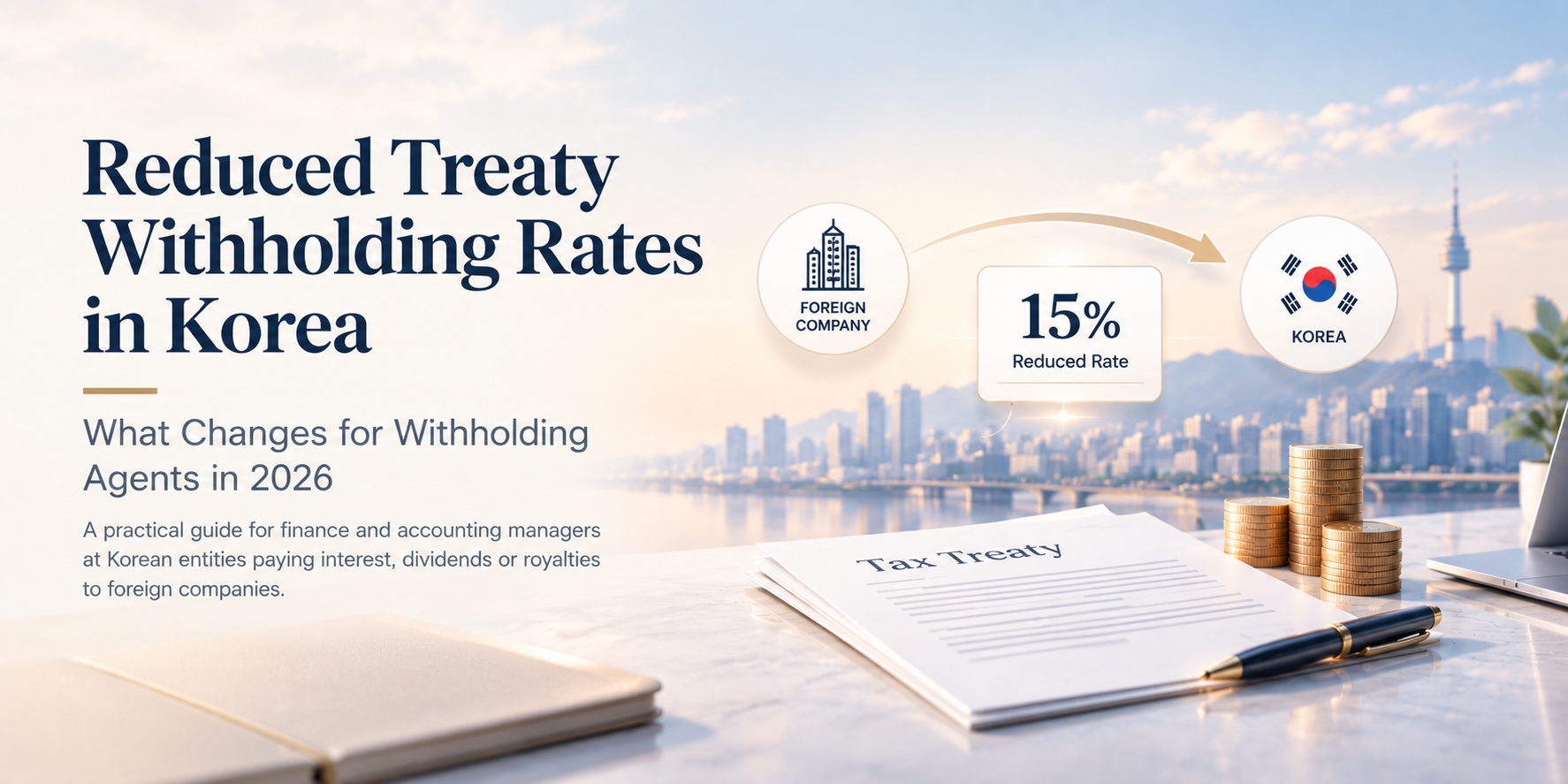
When a Korean company pays domestic source income to a foreign company, a tax treaty may allow a lower withholding rate than the domestic statutory rate. This is the reduced tax rate. But a rate written into a treaty does not apply on its own — the foreign recipient has to submit an application to the Korean withholding agent first.
From 2026 there is a second step. The withholding agent now has a filing obligation of its own with the tax office. If your current process is "collect the form, keep it on file, produce it if asked," that process is out of date.
What Is the Application for Entitlement to Reduced Tax Rate?
Article 98-6 of the Corporate Tax Act requires a foreign company that is the beneficial owner of domestic source income and wants the benefit of a treaty reduced rate to submit two things to the Korean withholding agent: the Application for Entitlement to Reduced Tax Rate on Domestic Source Income (for Foreign Corporation), and documentation evidencing that it is the beneficial owner of the income. Where an overseas investment vehicle is treated as the beneficial owner, a Report of Overseas Investment Vehicle (OIV) setting out the country-by-country position of its investors is submitted alongside.
A typical case: a Korean company pays a copyright royalty to a Japanese company and wants to apply the reduced rate under the Korea–Japan tax treaty. The Japanese company — not the Korean payer — is the party that completes and submits the application.
When Does the Foreign Company Have to Submit It?
Before it receives the income. Article 138-7 of the Enforcement Decree of the Corporate Tax Act sets the deadline at the point before payment of the domestic source income, which means the paperwork belongs at the contract and payment-planning stage rather than the day before a remittance goes out.
Points to confirm in advance:
- Which country's foreign corporation is receiving the income
- The type of income — interest, dividends, royalties
- Whether a tax treaty is in place between Korea and that country
- The treaty rate applicable to that income type
- Whether the recipient is the beneficial owner
- Whether the application was submitted before payment
- Certificate of residence and beneficial ownership evidence
What Changed in 2026?
Previously the withholding agent that received the application kept it on file and produced it when the tax office asked. There was no standing obligation to file it anywhere.
From 2026 that changes. Under Article 98-6(4) of the Corporate Tax Act, the withholding agent must submit the application and related documents to the head of the competent tax office for the withholding agent's place of tax payment, by the last day of February of the year following the year in which the domestic source income was paid.
Worked through: a royalty paid to a foreign company on 31 August 2026, with the reduced rate applied, means the application is filed by the last day of February 2027.
Does It Go with the Monthly Withholding Tax Return?
No. The statutory deadline for the application is set separately from the deadline for the Withholding Tax Return, and the two do not move together.
If a royalty is paid during August, the Withholding Tax Return and payment are due by the 10th of September, while the application itself is due by the end of February of the following year under Article 98-6(4). It is not a mandatory attachment to the monthly Hometax filing.
Filing earlier than February is permitted. If you do file early, obtain the receipt and keep it with the application and the supporting documents.
What Happens If There Is No Application?
The treaty reduced rate does not apply. That is the consequence in three situations: the withholding agent did not receive the application; the documents submitted were deficient and the deficiency was not remedied on request; or the beneficial owner cannot be identified from the documents provided.
In any of these cases, withholding must be applied at the domestic statutory rate under Korean tax law. This is the reason to secure the application and supporting evidence before payment — it is not a formality that can be regularised afterwards.
Does a New Application Have to Be Obtained for Every Payment?
No. Article 138-7 of the Enforcement Decree provides that an Application for Entitlement to Reduced Tax Rate on Domestic Source Income, a Declaration of Overseas Investment Vehicle or a Report of Overseas Investment Vehicle (OIV) already submitted need not be resubmitted within three years of the date of submission.
If the content changes, though, a revised submission reflecting the change must be made before the first payment of domestic source income after the change arises. The 2026 form's completion instructions take the same line: a new application is required where there is a change in the corporate name, representative, taxpayer identification number, address or country of residence, or where three years have passed since submission.
Can the Documents Be Discarded After Filing?
No. The withholding agent must retain the application and related materials for five years from the day after the due date for payment of the withheld tax, and must produce them if the head of the competent tax office requests them.
In practice it is easier to manage one set of documents per transaction: the Application for Entitlement to Reduced Tax Rate, certificate of residence and beneficial ownership evidence, the contract, the invoice, the remittance record, the Withholding Tax Return, and the receipt. Assembled this way, the basis for applying the reduced rate can be explained end to end — from the transaction through to the withholding — in a single pass.
Reduced Rate and Exemption Are Not the Same Form
Where a treaty provides for a lower withholding rate, the Application for Entitlement to Reduced Tax Rate is used. Where the income is fully exempt from Korean tax under a treaty, the same form is not used.
The completion instructions for the application state this directly: the form is not submitted where withholding in Korea is exempt under a tax treaty. Exemption follows a separate application procedure.
For payments made from 2026, the sequence runs: the foreign company submits the application before payment, the Korean withholding agent reviews and applies the reduced rate, the Withholding Tax Return is filed and the tax paid, the application and related documents are filed with the tax office by the last day of February of the following year, and the documents are retained for five years. Only the fourth step is new.
How Daewon Tax & Accounting Corp. Can Help
Daewon Tax & Accounting Corp. supports foreign-invested companies across the full withholding tax cycle — reviewing treaty entitlement and reduced rate eligibility, preparing and filing Withholding Tax Returns, and managing the documentation required under the new filing obligation — working in both Korean and English with local finance teams and overseas counterparties.
If you would like your withholding process reviewed against the 2026 requirements, please get in touch.
Daewon Tax & Accounting Corp. (대원세무법인)
20, Eonju-ro 129-gil, Gangnam-gu, Seoul | Tel: 02-3016-3800 | Email: master@taxdaewon.co.kr
This article is general information, not tax advice for any specific taxpayer. The applicable reduced rate and the documents required will vary depending on the type of income, the beneficial owner, and the tax treaty with the counterparty jurisdiction; please confirm the current position before acting.
 1.png)