
When Should Founders Hand a Task Over to AI, and How Far?
A short survey for founders and startup teams – master thesis research at the University of St. Gallen
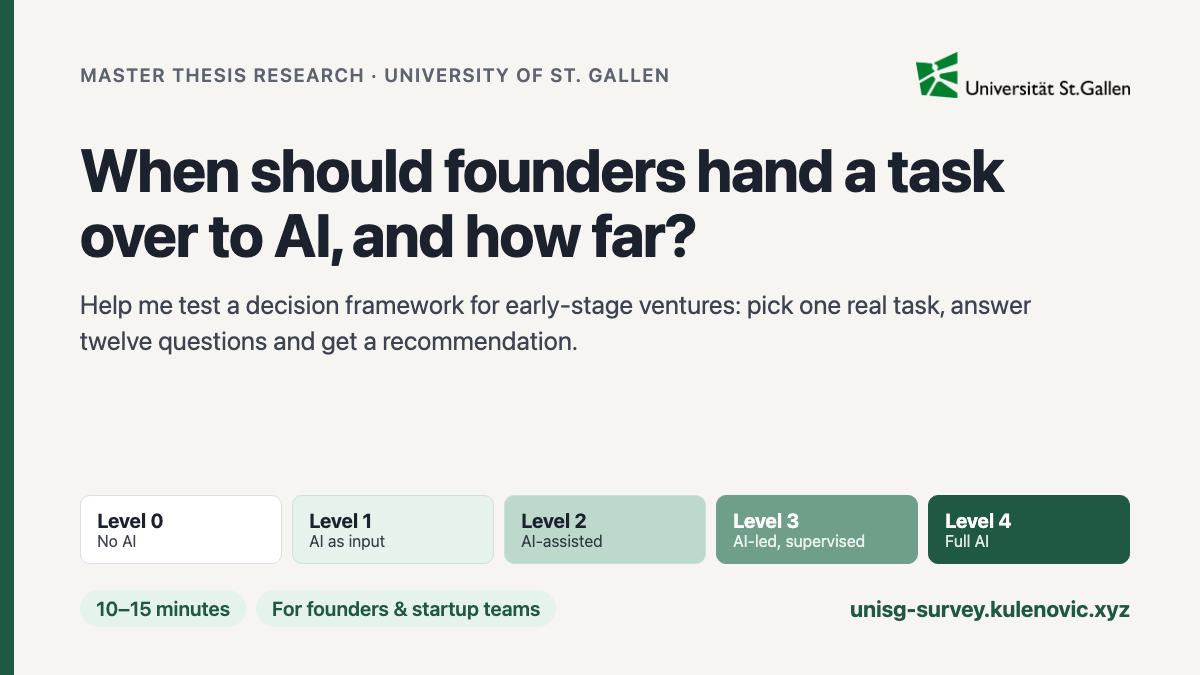
Take the survey (10–15 minutes): https://unisg-survey.kulenovic.xyz As a small thank you, ten participants who complete the survey will be drawn at random to receive a $50 Amazon voucher each.
Introduction
Hi everyone, I'm Jasminko, a master student at the University of St. Gallen (HSG) in Switzerland and a founder myself.
AI tools now let small founding teams do work that used to need specialists, agencies or extra hires: market research, pitch decks, code, marketing content, customer support. In my own venture I noticed that the hard part is no longer whether to use AI. The hard part is deciding which tasks to hand over to AI, how far to go, and where a person should stay in control.
That is exactly what my master thesis is about, and I would love your help to test it.
TL;DR: What My Research Is About
- The question: How can early-stage founders decide, task by task, how far to hand work over to AI?
- The output: a practical decision framework that gives a clear recommendation for a single task, from "no AI" to "AI runs it on its own".
- Why it matters: used well, AI makes young ventures faster and more capital-efficient. Used badly, it creates new problems: products that look like everyone else's, dependence on a few tools and providers, and founders who build in-house with AI what they should simply buy.
- How I test it: interviews with founders, investors, accelerator managers and AI providers, plus this survey, in which founders try the framework on one real task.
The Six Phases of Building a Venture
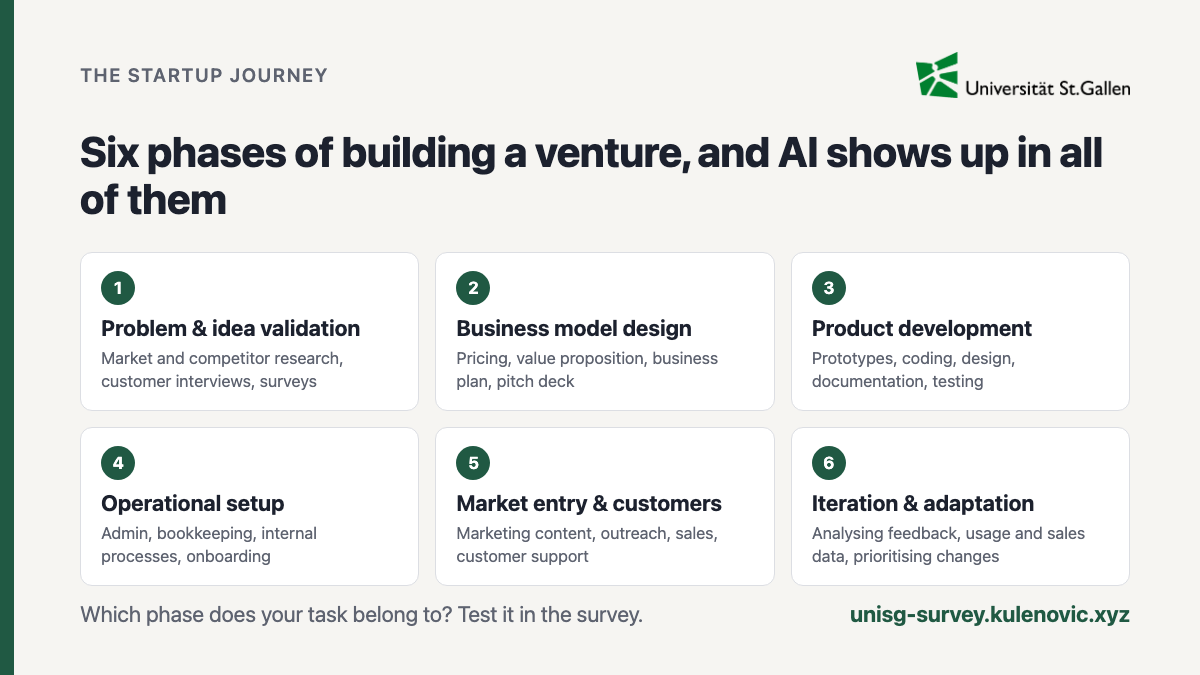
The thesis follows a startup through six phases. AI can support tasks in every one of them, but not every task in the same way:
- 1. Problem and idea validation: market and competitor research, customer interviews, surveys
- 2. Business model design: pricing, value proposition, business plan, pitch deck
- 3. Product development: prototypes, coding, design, documentation, testing
- 4. Operational setup: admin, bookkeeping, internal processes, onboarding
- 5. Market entry and customer acquisition: marketing content, outreach, sales, customer support
- 6. Iteration and adaptation: analysing feedback, usage and sales data, prioritising changes
The Framework: Three Steps, Twelve Questions
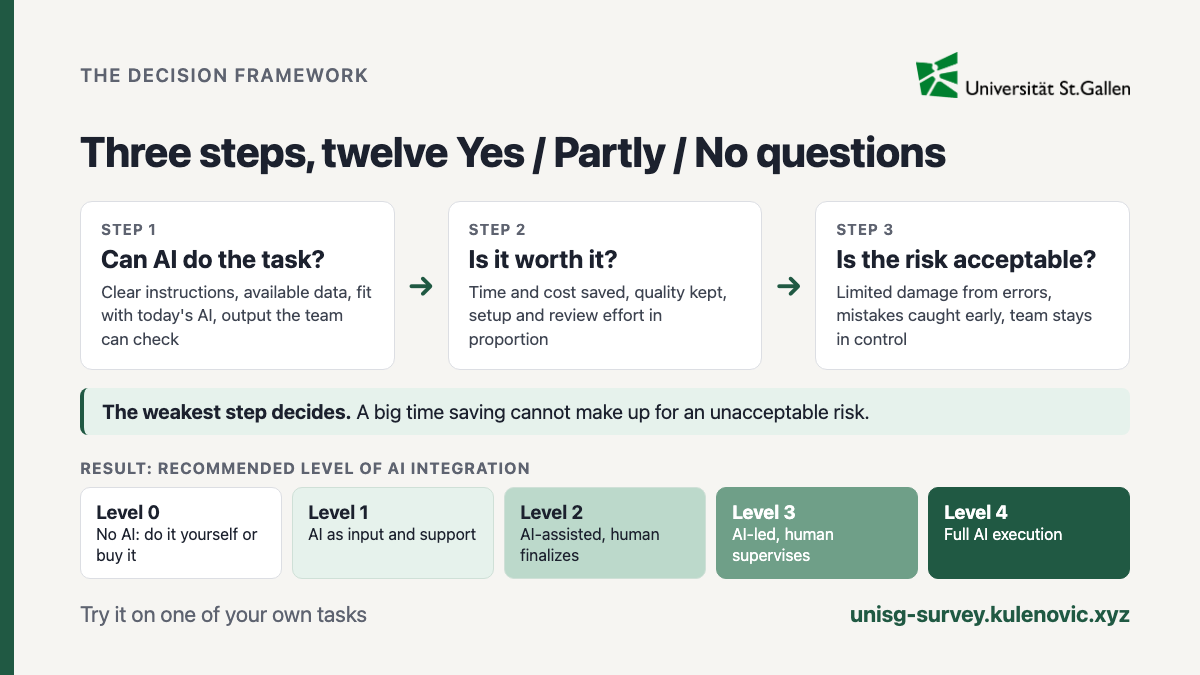
For one specific task, for example "writing the weekly LinkedIn post" or "answering customer emails", you answer twelve short Yes / Partly / No questions in three steps:
- 1. Can AI do the task? Can it be clearly described, is the needed information available, does it fit what AI can do today, and can your team check the result?
- 2. Is it worth it? Does AI really save time or money, is the quality good enough, and are the setup and review effort in proportion?
- 3. Is the risk acceptable? Would mistakes stay small, would you notice them in time, does your team stay in control, and is the task not the core of what makes your venture special?
The weakest step decides. A big time saving cannot make up for an unacceptable risk. The result is a recommended level:
- Level 0: No AI. Do it yourself, or buy it from a specialist.
- Level 1: AI as input and support. A person does the task; AI provides research, ideas or drafts.
- Level 2: AI-assisted. AI does meaningful parts; a person reviews and finalizes every result.
- Level 3: AI-led under supervision. AI does the routine work; a person approves at fixed checkpoints.
- Level 4: Full AI execution. AI runs the task on its own; a person monitors the overall system.
Take the Survey
I'm looking for founders, co-founders and early team members of startups, as well as people who lead a new venture inside an established company. You can also answer about a previous venture.
How it works: pick one real task from your venture, answer the twelve questions, and you immediately get a recommendation for that task. Afterwards I ask how well the recommendation fits your own experience. That feedback shows me where the framework works and where it needs to change.
👉 https://unisg-survey.kulenovic.xyz (10–15 minutes)
As a small thank you, ten participants who complete the survey will be drawn at random to receive a $50 Amazon voucher each. Taking part in the draw is optional.
Thank you very much for your time, and feel free to reach out if you'd like to talk about the topic or see the results:
Jasminko Kulenovic
University of St. Gallen