

Pillar Two in Korea: When Does a Korean Entity Need to File a GIR?
A practical guide for finance and accounting managers at Korean subsidiaries and branches of foreign-headquartered MNE groups.
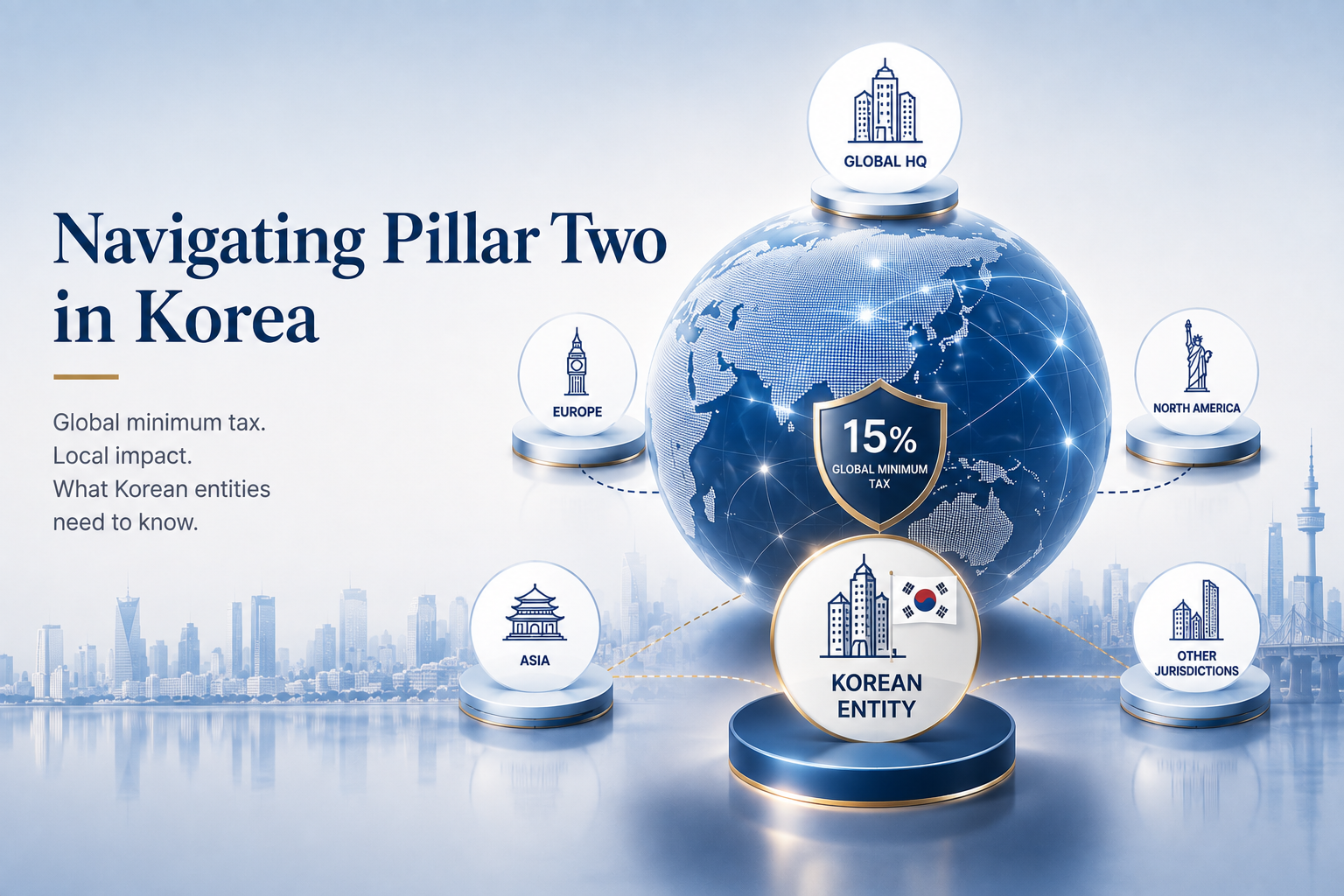
If your group is in scope for the Global Minimum Tax (GMT) under OECD Pillar Two, your Korean entity has a filing obligation in Korea — even when your headquarters sits in Amsterdam, Tokyo, or New Jersey, and even when the group's GloBE Information Return (GIR) is prepared entirely by the global tax team abroad.
The question is not whether Korea is involved. It is which document Korea expects from you, and by when.
Who Is in Scope for Korea's Global Minimum Tax Rules?
Korea's GloBE rules sit in the Adjustment of International Taxes Act (AITA, 국제조세조정에 관한 법률). The scope test is the standard OECD one:
A constituent entity is in scope if the ultimate parent entity's (UPE) consolidated financial statements show revenue of EUR 750 million or more in at least two of the four fiscal years immediately preceding the tested fiscal year.
Two points that trip up local finance teams:
- The test is applied at group level, not entity level. A Korean subsidiary with KRW 20 billion in revenue is fully in scope if the global group clears EUR 750 million. Your own P&L tells you nothing about whether you have an obligation.
- A Korean branch that constitutes a permanent establishment can also fall within the definition of a constituent entity. Branches are not exempt simply because they are not separately incorporated.
Korea has phased the rules in as follows:
Charging ruleApplies to fiscal years beginning on or afterIncome Inclusion Rule (IIR)1 January 2024Undertaxed Profits Rule (UTPR)1 January 2025Domestic Minimum Top-up Tax (DMTT)1 January 2026
The DMTT is the newest piece and the one most relevant to foreign-invested Korean companies. Enacted in the 2025 tax reform package, it lets Korea collect top-up tax on low-taxed Korean constituent entities before another jurisdiction can collect it under its IIR or UTPR. If your Korean entity has a GloBE effective tax rate below 15% — typically through R&D tax credits, foreign tax credits, or timing differences — Korea may impose a domestic top-up tax on low-taxed Korean constituent entities under its DMTT rules.
Which Filings Does a Korean Constituent Entity Actually Have to Make?
There are three key filing documents to consider. They are not alternatives to one another in every case, and confusing them is the most common source of missed deadlines.
1. The GloBE Information Return (GIR) The full return: constituent entity information for the entire group, jurisdiction-by-jurisdiction ETR computations, safe harbour elections, top-up tax allocations. It is very large, and it is a group-level product. A Korean subsidiary is rarely in a position to prepare it on its own.
2. The Foreign Constituent Entity Information Return (국외소재구성기업정보신고서) Filed in Korea where the GIR filing obligation is relieved for one of the reasons set out below. It tells the Korean tax authorities which foreign constituent entity is filing the group's GIR and in which jurisdiction.
3. Return on Allocable Share of Top-Up Tax (추가세액신고서) A separate Top-up Tax Return is required where a Korean constituent entity is liable to pay an allocated top-up tax amount or a domestic top-up tax allocation amount. This is a payment return, not an information return, and it is not replaced by either of the two above.
When Can a Korean Entity Be Relieved of the GIR Filing Obligation?
By default, every Korean constituent entity of an in-scope group must file a GIR. In practice, two exemptions do most of the work.
Exemption 1: Another Korean constituent entity files the GIR
If the group has several Korean entities and one of them files the GIR on behalf of the others, the remaining Korean entities do not file separately. What you need to confirm internally is straightforward but easy to leave unconfirmed: which Korean entity is filing, and whether your entity is actually included in that return.
Exemption 2: A foreign constituent entity files the GIR — subject to one condition
This is the route most foreign-headquartered groups take. But the exemption is not automatic simply because headquarters filed something somewhere.
The condition is this: an activated automatic exchange relationship for GIR information must be in place between the filing jurisdiction and Korea. Korea has signed the Multilateral Competent Authority Agreement on the Exchange of GloBE Information (GIR MCAA), but signing is only the first step — each bilateral exchange relationship has to be separately activated, and the OECD publishes the current list.
The practical consequence deserves emphasis, because it is where groups get caught:
If your group files its GIR centrally in a jurisdiction that has not activated GIR exchange with Korea, your Korean entity's GIR obligation is not discharged. Korea may still expect a local filing.
Which jurisdictions can currently send GIR information to Korea?
As of the OECD's 27 August 2026 update, the following jurisdictions have an activated GIR MCAA exchange relationship into Korea:
Australia · Austria · Canada · Croatia · Denmark · Finland · Gibraltar · Hungary · Ireland · Italy · Japan · Liechtenstein · Luxembourg · Netherlands · Norway · Slovenia · South Africa · Spain · Sweden · Switzerland · United Kingdom
Signing the GIR MCAA is not the same as having an activated exchange relationship with Korea, and activations are added on a rolling basis, so confirm the position at the time of filing:
- OECD — Automatic Exchange of Information: Exchange relationships (select the GIR MCAA table and filter to Korea)
Why the Foreign Constituent Entity Information Return Matters More Than It Looks
The 국외소재구성기업정보신고서 is administratively light — but skipping it is not an option, and it is the piece that most often falls between headquarters and the local team. HQ assumes Korea is covered by the central GIR filing; the Korean team assumes HQ has handled everything.
Before the deadline, get written confirmation from your group tax team on six points:
- 1. Is the group in scope for the Global Minimum Tax for this fiscal year?
- 2. In which jurisdiction is the group's GIR being filed?
- 3. What is the name and jurisdiction of the filing constituent entity?
- 4. Is the GIR exchange relationship between that jurisdiction and Korea activated?
- 5. Is the Korean entity included in that centrally filed GIR?
- 6. Is there any Korean top-up tax exposure requiring a separate Top-up Tax Return?
Points 3 and 4 are the ones to chase hardest. A group tax team can answer "yes, we file centrally" without knowing whether Korea is on the receiving end of that exchange.
What Are the Korean Filing Deadlines?
Korea follows the OECD transitional timing:
- First application fiscal year: 18 months after fiscal year end
- Subsequent fiscal years: 15 months after fiscal year end
For a December year-end Korean entity, that produces:
Fiscal yearFiling deadlineFY2024 (first application year)30 June 2026 — now passedFY202531 March 2027FY202631 March 2028
If your Korean entity did not file anything for FY2024, that gap does not resolve itself. Where a central GIR was filed abroad but no Korean information return was made, the exposure should be assessed and remediated rather than left open — the position is generally better addressed on a voluntary basis than after an inquiry.
For FY2025, the working deadline for calendar-year entities is 31 March 2027. That sounds distant, but the information you need lives with your group tax team, and the confirmations above typically take several rounds of email to obtain.
A Practical Checklist for Korean Constituent Entities
- Confirm the group's consolidated revenue against the EUR 750 million test for the relevant look-back years
- Identify every Korean constituent entity in the group, including branches
- Determine whether a Korean entity or a foreign entity is filing the GIR
- Verify that the GIR filing jurisdiction has an activated exchange relationship with Korea
- Confirm whether Korea requires a GIR or only a Foreign Constituent Entity Information Return
- Assess Korean top-up tax exposure separately — under the IIR, the UTPR, and from FY2026 the DMTT
- Model the Korean GloBE ETR early if your entity uses R&D credits or has significant deferred tax movements
- Check FY2024 compliance status if it was not addressed at the time
How Daewon Tax & Accounting Corp. Can Help
Global Minimum Tax compliance does not behave like a corporate income tax return or a transfer pricing filing. It requires consolidated group data, jurisdiction-level ETR computations, constituent entity mapping, and a current read on exchange relationship status — coordinated across a Korean entity and a group tax function that may be several time zones away.
Daewon Tax & Accounting Corp. advises foreign-invested companies and multinational groups in Korea on Global Minimum Tax scoping, GIR filing obligations, Foreign Constituent Entity Information Return filings, Top-up Tax Return review, and the broader international tax compliance cycle — working in both Korean and English with local finance teams and overseas group tax departments.
If you need your Korean Pillar Two position reviewed, please get in touch.
Daewon Tax & Accounting Corp. (대원세무법인)
20, Eonju-ro 129-gil, Gangnam-gu, Seoul Tel: 02-3016-3800 | Email: master@taxdaewon.co.kr
This article is general information, not tax advice for any specific taxpayer. Exchange relationship data is as at the OECD's 27 August 2026 update. Global Minimum Tax rules and OECD exchange relationship activations change frequently; please confirm the current position before acting.
 1.png)